Tuesday, July 31, 2012

SHEPHERDSTOWN BAKERY


The next time you visit the Harpers Ferry area, take a short drive over to Shepherdstown -  the oldest town in the state of West Virginia, nestled in the lower Shenandoah Valley and the home of Shepherd University founded in 1871.  Shepherdstown is only 90 minutes from the Washington/Baltimore metropolitan area but miles away from the stress and rushed lifestyle of the city.   Browse the many quaint little shops that line German Street.  And for a special treat stop by the Shepherdstown Sweet Shop for a little something special.  Located at 100 West German Street - you'll feel like a kid in a candy shoppe!


Dave and I always stopped by for a great cup of coffee or a piece of cake or a donut or a cupcake or a fruit-filled tart.  Local papers line the wide windowsills along with information on concerts and other local happenings.  They have a large selection of local area wines and lots of other treats, too!


Beer and Brown Sugar Kielbasa & Sauerkraut


Yield: About 10 servings

Prep Time: 10 minutes | Bake Time: 4 to 8 hours

12 ounces beer (can or bottle)
1 cup brown sugar (light or dark)
3 pounds polish kielbasa
1 bag (or jar) sauerkraut (32 ounces), drained


1. Combine the beer and brown sugar in a small saucepan over medium heat, until the sugar melts and the mixture is slightly thickened; set aside.

2. Cut the kielbasa into links and place in a slow cooker. Cover with the drained sauerkraut. Pour the beer and brown sugar mixture over top. Cook on high for 4 to 6 hours, or on low for 8 to 10 hours. (We ended up doing a combination – high for 3 hours and then low for another 3 or so. Definitely the longer it cooks the better it tastes!)

3. Serve on its own or on your favorite sandwich roll.

Land that I love. . .

PAW PAW, WV TUNNEL

PAW PAW, WEST VIRGINIA TUNNEL
 ON THE C AND O CANAL TOWPATH


The tunnel is 3,118 feet long and you can just barely see the light at the other end. I think it's kind of spooky, especially in the middle where it's dark. And cold. And wet. There is a (steep) hiking trail around the outside of the tunnel if you don't like dark  and wet and creepy places.  But Dave and I loved it and would take the kids through the tunnel whenever we could - shouting and hooting to hear our voices bounce off the walls.  


Paw Paw Boardwalk.jpg (136874 bytes)


This boardwalk and guard rail starts a few hundred feet before you see the tunnel. Once you're inside, walking in the dark, it's all you have to guide you to the other end.


Photo taken of two hikers at the mouth of the Paw Paw Tunnel (taken sometime in 1972).


DIRECTIONS FROM BALTIMORE:
Merge onto I-695 N/Baltimore Beltway Inner Loop via EXIT 49B
 toward I-70/Towson.
Merge onto I-70 W via EXIT 16 toward Frederick.

Merge onto US-522 S via EXIT 1B on the left toward Hancock/Winchester
 (crossing into West Virginia).

Turn right onto WV-9/Union St. Continue to follow WV-9.

WELCOME TO PAW PAW, WEST VIRGINIA!

Saturday, July 28, 2012

Land that I love. . .

DAYTRIPPING

Shepherdstown, Antietam, Harpers Ferry, Sharpsburg and Gettysburg - names of formerly unknown little towns that played major roles in the Civil War.  If you are a Civil War buff or if you just like to explore quaint little towns - this is the area for you!  Each town is just a short drive from the Baltimore/Harford County area which makes it so convenient for daytripping!

Here are a few photos from my recent exploration of the area.


Friday, July 27, 2012

Land that I love. . .

Landon and Me at the Harpers Ferry KOA

My daughter, Sara, and her husband, Mike, just hiked the Appalachian Trail from PenMar, PA to the George Washington Monument State Park in Boonsboro, MD - 22 miles in two days!  They left on Tuesday evening and I picked up the happy hikers yesterday at the State Park. 


While they were on the trail I got to enjoy some precious time with Landon at the Harpers Ferry KOA.  We are going to be in West Virginia until Monday morning.  Having a great time!


 Landon loves the free breakfast served each morning!  Did someone say pancakes?


And he got to play a little basketball, too!


Of course, the best times are with old friends.


Enjoy the upcoming weekend!

Thursday, July 26, 2012

Land that I love. . .


C AND O CANAL TRAIL

This is a really nice hike especially from Brunswick, MD to Shepherdstown, WV (where Dave and I used to live when our middle son, Jason, was just a toddler).


History & Culture


Women on a canal boat
In the 19th and early 20th century the C&O Canal provided jobs and opportunities for people throughout the Potomac River Valley, from the tidal basin in Washington D.C. to the mountains of Western Maryland.

In a little less than one hundred years, the C&O Canal witnessed a race west by transportation giants, the growth and decline of communities and businesses along the banks of the Potomac River, fierce battles raging between a divided nation, and improvements in technology that made life along the canal obsolete.

Today the remains of the C&O Canal provide a place to recreate and enjoy nature, but most importantly they tell the story of the canal's important role in America's history. Stories of western expansion, transportation, engineering, the Civil War, immigration, industry and commerce.

Discover the fascinating people, places, stories and collections that compose the C&O Canal's unique history!  Hike the C and O Canal Trail! 

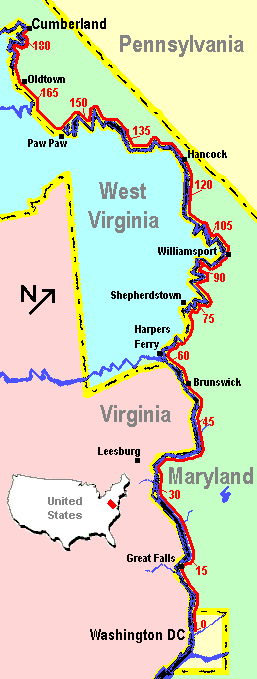
Overview map of towpath


Did You Know?

     The C&O Canal begins in Georgetown. 
The canal made extra money by selling water to numerous factories in
Georgetown to power water driven machinery such as water wheels, etc. 
Many factories were located next to canal property.

Grilled & Marinated Tuna Kebabs


Ingredients:
1/2 pound tuna steak
1 red bell pepper
1 green bell pepper
1 small onion
6-10 large button mushrooms
2 lemons, cut into wedges
Marinade Ingredients
1/2 cup olive oil
2 Tbsp chopped onion
1 Tbsp chopped fresh rosemary
1 Tsp salt
1/2 Tsp black pepper
2 garlic cloves


Directions:

Cut all the fish and veggies into similar-sized pieces; this helps everything lay flat when it is on the grill. To make the marinade, purée the onion, rosemary, garlic, salt and pepper in a food processor. Drizzle in the olive oil while puréeing, continue to purée until smooth, about 1-2 minutes. Coat the fish and veggies in the marinade. Set in the fridge for at least an hour and up to overnight.
When skewering the fish and vegetables, pierce the fish against the grain, and select pieces of veggies that are close to the same size as your fish. This is important, because
if the pieces are different widths, some things will be charred and others undercooked. You also want to be careful when loading up the skewers; it’s easy to stab yourself by accident! Alternate pieces of fish with pieces of various veggies, leaving a little space between everything. Don’t crowd the skewer, or the parts that are touching will cook too slowly.
Lay the skewers on the grill. Don’t move them until the fish pieces are well browned on one side, about 3-6 minutes. Then using tongs, carefully turn the skewers over and cook them until they are seared on the other side. Serve hot or at room temperature. Drizzle with lemon juice or serve with lemon wedges.
Serves 4.

Wednesday, July 25, 2012

CAST IRON SKILLET COOKING-BLACKBERRY COBBLER

Cast iron recipes make great one skillet meals. Cast iron skillets are the perfect tool for cooking a range of cast iron skillet recipes from a simple side of sautéed cabbage to a whole roasted chicken. And consider the health benefits of cast iron recipes: food cooked in a cast-iron skillet, especially acidic foods like tomato sauce, has increased iron content, in some cases up to 20 times as much.
Plus, cast iron skillets conduct heat beautifully, go from stovetop to oven with no problem, and after decades of making cast iron skillet recipes, they're as good as new. To season your cast iron skillet, cover the bottom of the pan with a thick layer of kosher salt. Add at least half an inch of cooking oil and place over high heat. When the oil starts to smoke, pour the salt and oil into a bowl. Using a ball of paper towels, rub the inside of the pan until it is smooth. The cast iron skillet is now seasoned. When you clean your cast iron skillet, never use soap. Simply scrub your skillet with a stiff brush and hot water and dry it completely.


Blackberry Cobbler Recipe

Recipe Type: Blackberries, Biscuit, Dessert, Cobbler
Yields: 10 to 12 servings
Prep time: 15 min
Bake time: 20 min

Ingredients:

6 to 8 cups fresh or frozen blackberries*
1 1/2 cups granulated sugar
1/2 cup all-purpose flour
2 tablespoons fresh-squeezed lemon juice
1 to 2 tablespoons blackberry liqueur, optional
Biscuit Topping (see recipe below)
Vanilla ice cream

* The amount of blackberries used depends on the size of your pan. If using a Cast-Iron Skillet, use 6 cups - 13x9-inch baking pan, use 8 cups.

Preparation:

Preheat oven to 400 degrees F. Line a baking sheet with aluminum foil (this is to catch the blackberry juice that usually boils over from the baking dish or skillet).
If using fresh blackberries, wash, stem, and drain blackberries.
In a large bowl, combine sugar, flour, blackberries, lemon juice, and blackberry liqueur. Pour into prepared baking dish or skillet.
Bake, uncovered, 15 to 20 minutes or until hot and bubbly. When blackberry mixture is hot, remove from oven and spoon Biscuit Topping mixture onto the top in 10 to 12 large spoonfuls. Return to oven and bake another 20 to 25 minutes or until biscuits are lightly browned and a toothpick inserted in the center of one of the dumplings comes out clean.
Remove from oven and cool on a wire rack for at least 10 minutes before serving. Serve either warm or room temperature. To serve, top with vanilla ice cream.
Makes 10 to 12 servings.
 

Blackberry CobblerBISCUIT TOPPING:
2 cups all-purpose flour
4 teaspoons baking powder
3 tablespoons granulated sugar
1 teaspoon salt
Zest (peel) of 1 lemon
1/2 cup chilled butter, cut into 1/4-inch pieces
2/3 cup milk
1 egg, slightly beaten

In a large bowl, sift together flour, baking powder, sugar, salt, and lemon zest.
With a pastry blender or two knives, cut in butter until particles are the size of small peas. Add milk and egg; stir with a fork just until blended.

REHOBOTH BEACH, DELAWARE


Rehoboth Beach is a welcoming, friendly community.  One mile square, the seaside town has all of the modern amenities.  It is a place where people can stroll down tree-lined streets, neighbors know one another, children play outside and a diverse community comes together to preserve the city’s charm and unique character.

The History of Rehoboth Beach, Delaware

The earliest settlers to this area were Native Americans who traveled to the beach in the summer months to enjoy the cool breezes and abundant seafood.  Between 1650 and 1675, English and Dutch settlers put down roots here as the area became home to farmers and members of William Penn's earliest legislatures.

Later owners participated in the American War of Independence.  According to information from the Rehoboth Beach Historical Society, in 1872, Reverend Robert W. Todd of St. Paul's M.E. Church in Wilmington visited a Camp Meeting area on the Jersey Shore.  He soon pursued the idea of starting a camp area here on the Delaware coast.  In 1873, on 414 acres purchased from local farmers, the Rehoboth Camp Meeting Association was formed.

The grounds were laid out in a fan-shaped design with wide streets, parks and specific building lots.  That design remains largely intact today.  While the Association discontinued its formal meetings by 1881, other groups utilized the site for services until about the turn on the 20th century.  In 1891, Delaware's General Assembly established a municipality for the territory, naming it Henlopen City.  In 1891, it was renamed Rehoboth Beach.

The Boardwalk, now a mile long, was originally built in 1873 on high ground between the beach and Surf Avenue, which ran the full length of the ocean front.  Many storms have changed the configuration over the years; but in 1879, the original Henlopen Hotel was built on the site now occupied by a hotel of the same name.

With the coming of the railroad - which ran right down Rehoboth Avenue, the second block of Baltimore Avenue became the new center of camp meetings and city life.  Many of the original tent houses (small one-room buildings surrounding a center structure) were moved there with new ones constructed as well.

In 1925, a paved highway was completed from Georgetown to Rehoboth Beach.  It helped link the resort with the paved roads towards Washington, D.C.; and many legislators, diplomats and government employees began to visit and vacation here.  It wasn't long before Rehoboth Beach came to be known as the "Nation's Summer Capital".

From it's beginnings as a spiritual center to the public's embracing of the seacoast as a mecca for leisure activity, Rehoboth Beach has developed as a close-knit seaside town.  It's a nod to the past that the city's present day charter includes words that are nearly identical to several words from the 1872 charter of the Camp Meeting Association:

"the maintenance of a permanent seaside resort and the furnishing of proper conveniences and attractions requisite to the same."

Downtown Rehoboth Beach came of age in the era of Victorian influences and evolved throughout the 20th century to change with the times.  Both the residential and commercial area, despite their growth and maturation, have retained the warm and friendly charm and ambiance that reflect Rehoboth Beach's historic past.

From Baltimore, MD
  • I-97 SOUTH to US-50 EAST
  • Go EAST on US-50 (cross Bay Bridge - toll) to ROUTE-404
  • Go EAST on ROUTE-404 to ROUTE-16 EAST
  • Go EAST on ROUTE-16 to ROUTE-1 SOUTH
  • Go SOUTH on ROUTE-1 toward Rehoboth & Dewey Beaches
  • Follow Route 1 for about 20 minutes, take the LEFT exit for 1A (Rehoboth Beach - Henlopen Acres). 1A becomes Rehoboth Avenue and ends at the Boardwalk. Trip time is about 2 hours.

RV TIPS AND HINTS

WHAT IS THE BEST TYPE OF RV FOR ME?

The basic categories of RVs are:

  • Motorhomes (including Bus Conversions)
  • Travel Trailers (or towables)
  • Truck Campers

    Motorhomes are your vehicle and living quarters combined.
    Travel trailers must be towed by a separate vehicle.
    A truck camper is living quarters that sits in the back of a pick-up truck.

    Motorhomes

    Let’s start with motorhomes. Motorhomes are further divided into classes.


    'Class A Motorhome' Class A Motorhomes
    Class A motorhomes are the largest. They are the RVs most people think of when you use the term RV. Although different than Class A motorhomes, Bus Conversions are also large (and can be luxurious) and they are the rigs most often associated with stars and athletes that travel over the road from city to city.


    'Class B Motorhome' Class B Motorhomes
    Class B motorhomes are the smallest and are built on a van chassis. Although there are full-timers in Class Bs, they are generally too small to live in for long periods of time.


    'Class C Motorhome' Class C Motorhomes
    Class C motorhomes are also built on a van chassis and are often referred to as mini-motorhomes although they can be as long as many of the Class As. They are distinguished by an extended section over the cab which usually contains an extra bed.


    Travel Trailers (Towables)

    Towables include true travel trailers, fifth wheels, pop-up campers, and all others that are towed. Though there are full-timers in all shapes and sizes of towable RVs, only travel trailers and fifth wheels are practical for long-term living for the majority of people.


    'Travel Trailer' Travel Trailers
    Travel trailers are large trailers towed completely behind the tow vehicle. They are hitched to the back of the tow vehicle which can be anything that has enough power and torque to pull the trailer.


    'Fifth Wheel' Fifth Wheels
    Fifth wheels are trailers that have a gooseneck front section that extends over the bed of the pick-up truck (usually) tow vehicle. The hitch is located in the center of the truck bed, so fifth wheels can only be towed by pick-up or flat bed trucks.
    NOTE: Many full-timers choose to pull their trailers with, large, semi-looking Medium Duty Trucks (MDTs) or Heavy Duty Trucks (HDTs). For very heavy trailers, MDTs & HDTs provide more saftey in going down long, steep inclines and in stopping emergencies, but the trade-off is having to use them for store runs and exploring.

    Travel Trailers vs. Fifth Wheels
    Between travel trailers and fifth wheels, travel trailers are generally less expensive. Fifth wheels tend to have more living space and are easier to tow.
    With fifth wheels having much of their weight positioned over the tow vehicle, they are less susceptible to jack-knifing or fish-tailing. At least one source I have read stated that fifth wheels are the most popular among full-timers, but it seems to us to be about 50/50 between fifth wheels and motorhomes.


    Motorhomes vs. Towables


    Again, the type of RV you choose is largely personal preference. However, there are some basic differences that may help you decide.

    Motorhome Pros
  • Non-drivers can pursue other activities while on the road (although it is highly recommended that they stay seated with belts on).
  • You do not have to stop for bathroom breaks (but again, it is not recommended that you walk in the rig while in motion).
  • You do not have to go out in bad weather to get to the living quarters when you stop.
  • Many motorhomes have self-leveling jacks so there is no need to place boards or blocks under wheels to level.
  • Motorhomes are a little easier to move and set up.
  • Motorhomes allow you to tow just about any vehicle for exploring local areas.

    Motorhome Cons
  • If something needs to be repaired, your entire home has to go into the shop and you may have to find other accommodations until all parts are in and the problem is fixed.
  • Motorhomes tend to be more expensive than towables, even when factoring in a tow vehicle for the towable.
  • Motorhomes generally have less living space than travel trailers and fifth wheels.
  • Because Motorhomes have a lot of value tied up in the motor, they depreciate faster.
  • When towing a second vehicle, you cannot back up, you have the cost and maintenance of the second vehicle, and you are back to having towing and hitching hassles.

    Towable Pros (large travel trailers and fifth wheels)
  • They are less expensive and hold value longer.
  • They have more living space.
  • Because they require a tow vehicle, you can leave the RV and take the tow vehicle on short runs.
  • It is usually the motorized vehicle that needs repair, so if the tow vehicle is in the shop, you still can live in the RV.

    Towable Cons
  • Towing and hitching/unhitching large trailers can be a hassle (although our experience has been that fifth wheel hitching/unhitching is about as easy as it gets).
  • Due to overall length, parking and finding campsites can be a problem.
  • Non-drivers cannot legally be in the trailer while moving.
  • Depending on the size of the towable, the tow vehicle could be more expensive than the RV, and could make the overall cost rival a motorhome.
  • Because of the size of the tow vehicle necessary to pull a full-timing trailer, exploring the area may be a less comfortable ride than in a vehicle towed behind a motorhome.
  • If financing, the tow vehicle loan cannot be spread over a long term like RV loans; therefore, monthly payments could be higher on a trailer/tow vehicle combination than on a motorhome.

    Decisions, Decisions

    So how do you decide? Research, read, go to dealer lots, go to RV shows, and ask questions of full-timers that are on the road and on internet forums. You will develop preferences.
  • Land that I love. . .

    Tuesday, July 24, 2012

    DAVE'S TUNA GLOP


    My husband loved camping.  He would take hours to get his backpack ready and get our supplies in order - making lists for the supermarket, shopping for the groceries. 

    This is the most simple and basic recipe for dinner.  I know all of my children will remember


    DAVE'S TUNA GLOP


    Ingredients:
    Instant rice
    Cream of mushroom soup
    Canned tuna

    There's no measuring here.  You can make this as thick as you like.  You can use one or two cans of the soup and tuna depending on how many people you need to feed.  You can add water to the soup if you want to stretch the recipe but you don't have to. 
    When I asked Dave when we first met how he made this, he said "Throw it all in the pot and wait for it!"

    You can also add other ingredients if you want - although we always enjoyed the three ingredient "glop".   Canned mushrooms, diced onion or celery and/or frozen peas make a delicious variation of this recipe.  You can also change this up and add diced chicken or ham instead of tuna.   
    Serve with warm buttered dinner rolls and you have a hearty and filling meal.


    Dave in our camping days.